
Examples of RedShield’s Approach to Vulnerability Mitigation
Make exploit paths fail - before traffic reaches your application.
RedShield combines an expert-tuned WAF with in-flight patches that intercept and rewrite requests, making exploit attempts safe before they reach your application. No code changes needed.
Advanced patches can also add security controls like MFA, site scraping protection, and bot defence.
TYPICAL WAF APPROACH
Block suspected attacks
A WAF relies on signatures, anomaly scores, and rule sets to detect malicious requests. It can stop known patterns, but sophisticated attackers can bypass static detection.
Decision: allow or block
REDSHIELD APPROACH
Make the request safe
In-flight patches normalise, sanitise, and transform traffic so applications receive safe inputs. Exploit paths fail because vulnerabilities are neutralised in transit.
Action: rewrite and secure
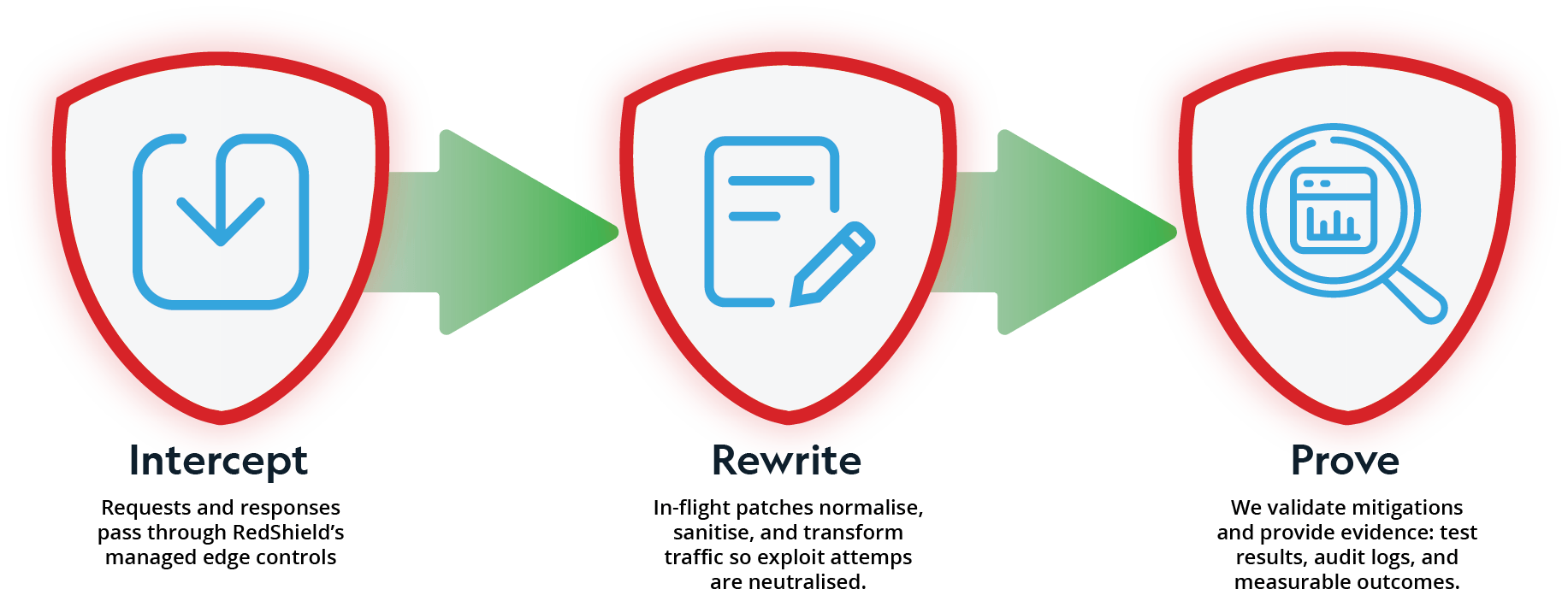
Change control
Stage, test, approve, and deploy patches with clear ownership and auditability.
Fast rollback
Disable a patch quickly if behaviour changes or unexpected edge cases appear.
Observability
Security events and correlation IDs can be forwarded to SIEM and SOC workflows.
Low disruption
Rewrite policies can preserve legitimate user input while neutralising exploit payloads
HOW REWRITING LOOKS IN PRACTICE
Before and after: traffic is transformed
so the application receives safe input
These are simplified examples. The key idea is consistent: normalise parsing, sanitise inputs, and harden responses.
REQUEST EXAMPLE
Normalise + sanitise repeated parameters (HPP-style evasion)
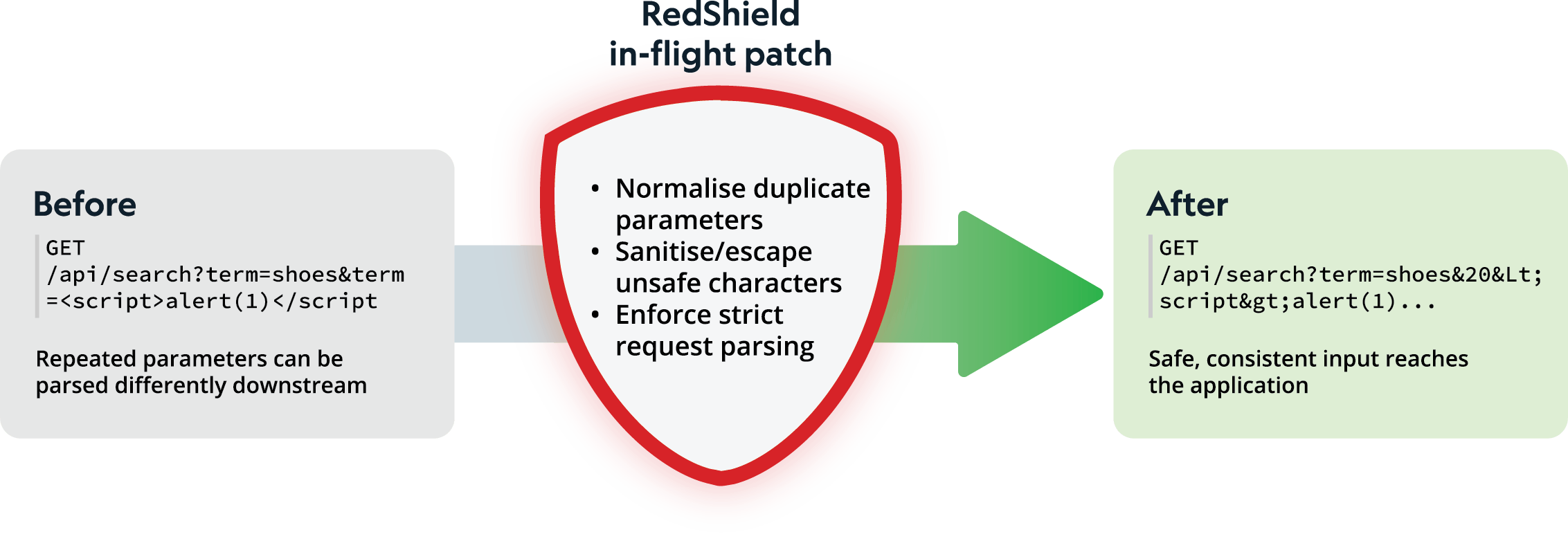
Normalisation removes parsing ambiguity. Sanitisation ensures exploit strings arrive harmless.
RESPONSE EXAMPLE
Harden session handling and browser protections
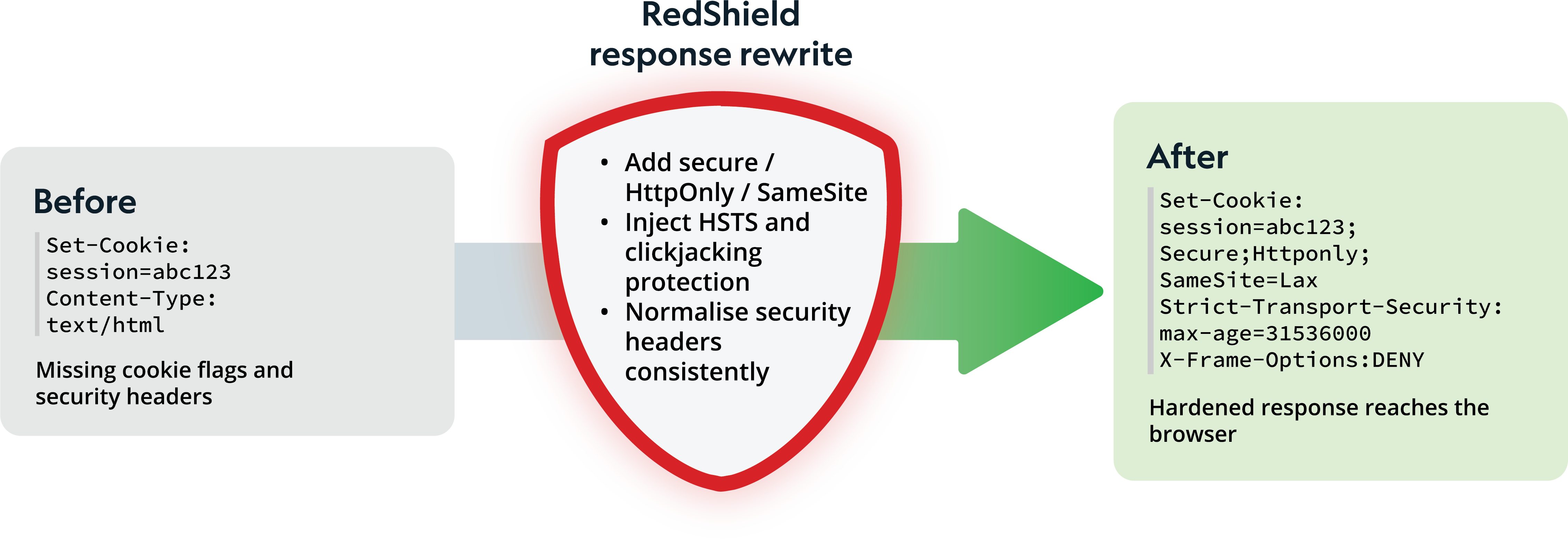
Response rewriting reduces session theft risk and raises the bar for browser-based attacks.
EXAMPLES
Concrete examples across common weaknesses
and modern threats
Use the search and filters to explore how RedShield mitigates different vulnerability types.
| Vulnerability Type | CWE | Typical Business Risk | How RedShield Mitigates It |
|---|---|---|---|
| Automated threat: distributed abuse correlation | CWE-799 | Coordinated bot/fraud campaigns across many IPs and accounts | Correlate signals across sessions and identities (geo consistency, email/DNS checks, parameter integrity); apply cheap-first validation and block campaigns that show coordinated traits. |
| Automated threat: economic countermeasures | CWE-799 | Persistent abuse that remains profitable for attackers | Apply optional cost-of-abuse controls (proof-of-work, holds, friction or paid actions) to reduce attacker ROI while keeping legitimate journeys usable. |
| Automated threat: identity verification gates | CWE-284 | Account creation abuse and takeover at scale | Insert verification steps for high-risk flows (magic-link, email, document or payment-based checks as required); gate rate-limit exemptions and sensitive actions on successful verification. |
| Automated threat: scraping (deception) | CWE-799 | Data harvesting, competitive intelligence loss, increased load | Detect headless browsers and automation frameworks; route likely bots to deception responses (queues, honeypots, synthetic data) while preserving normal UX for legitimate users. |
| Broken object-level authorisation / IDOR | CWE-639 / CWE-284 | Unauthorised access to other users’ records | Rewrite external object identifiers into user-scoped opaque tokens; enforce entitlements; translate to internal IDs only when authorised; otherwise return an indistinguishable safe 404/403. |
| Cleartext credential transmission | CWE-319 | Credential interception and session theft on untrusted networks | Enforce HTTPS end-to-end; optionally encrypt credentials in the browser and decrypt at the proxy before forwarding to legacy backends that cannot be updated. |
| Client-side authentication bypass | CWE-602 | Unauthorised access by skipping front-end checks | Remove reliance on client-side authentication logic by enforcing checks at the proxy; accept credentials via secure POST, validate centrally, and ignore client-controlled authenticated flags. |
| Client-side integrity: code exposure and IP theft | CWE-200 | Reverse engineering, scraping of business logic and embedded secrets | Harden delivered JavaScript by removing source-map exposure and applying real-time obfuscation where appropriate; reduce leakage of sensitive client-side logic and identifiers. |
| Compromised or breached credentials | CWE-521 | Account takeover using leaked passwords | On login, check submitted credentials against known breach corpuses and reputation sources; block high-risk attempts and force password reset or step-up verification when compromise is likely. |
| CORS misconfiguration | CWE-942 | Cross-origin data theft from authenticated sessions | Validate Origin against a strict allowlist and return only validated origins in CORS headers; prevent wildcard-with-credentials patterns and tighten preflight handling. |
| Credential brute force (high volume) | CWE-307 | Account takeover and service disruption | Track failed login attempts per username as well as IP; rate-limit and introduce challenges (CAPTCHA/lockout) once thresholds are exceeded. |
| Credential brute force (low and slow) | CWE-307 | Account takeover that evades simple rate limits | Inject lightweight human-interaction checks and behavioural signals on login/reset journeys; block automated tooling even when request rates are low. |
| Cross-site scripting (reflected/stored) | CWE-79 | Credential theft, session takeover, content injection | Rewrite response bodies to sanitise or context-encode attacker-controlled output (HTML/JS/URL) before it reaches the browser; neutralise dangerous tags/attributes and inline handlers. |
| CSP nonce injection (HTML rewrite) | CWE-79 (related) | XSS impact even when a bug exists | Generate a per-response nonce; set a strict CSP; rewrite HTML so script tags carry the nonce and inline execution is controlled, without code changes. |
| CSRF | CWE-352 | Unauthorised actions in a user’s session | Inject CSRF tokens into HTML forms and relevant AJAX calls in responses; validate tokens on submission; reject or rewrite requests that are missing/invalid. |
| DOM-based XSS | CWE-79 | Client-side takeover, data theft | Patch JavaScript in the response: replace risky DOM sinks with safe wrappers and remove unsafe assignments, without requiring an app redeploy. |
| Exposed admin interfaces | CWE-200 | Admin portal compromise and elevated-impact incidents | Hide admin routes behind a dedicated pre-authentication portal; return safe 403/404 externally until identity controls are satisfied, then apply step-up verification for sensitive admin actions. |
| Feature flag abuse and unauthorised feature access | CWE-16 | Early feature exposure and privilege/logic bypass | Enforce feature gating at the edge: validate required cookies/headers, apply controlled rollouts (canary percentages), and persist decisions safely with sticky cookies. |
| Field-level PII redaction in client responses | CWE-200 | Sensitive data exposure to end users and attackers | Rewrite outbound JSON/HTML to mask or remove sensitive fields on selected routes (e.g. redact tokens, show last four digits only), based on policy and user context. |
| GenAI: bot automation (AI solvers) | CWE-799 | Automated abuse that defeats traditional CAPTCHAs | Deploy rotating multi-modal challenges and interaction checks designed to resist solver farms and AI-assisted completion; escalate friction only when automation is suspected. |
| HTTP method abuse | CWE-749 | Unexpected state changes or bypass of application controls | Enforce method allowlists per route; block unsafe verbs and, where required, translate legacy tunnelled methods safely at the proxy before backend delivery. |
| HTTP parameter pollution (HPP) | CWE-235 | Validation bypass and ambiguous server-side parsing | Canonicalise duplicate parameters across query and body; apply consistent combining rules and reject malformed or ambiguous inputs before they reach application logic. |
| HTTP request smuggling (HRS) | CWE-444 | Request desync, cache poisoning and security control bypass | Normalise request headers to strict RFC parsing; reject ambiguous Content-Length/Transfer-Encoding combinations and other smuggling primitives before forwarding. |
| Information leakage via headers | CWE-200 | Reconnaissance enabling targeted attacks | Strip or rewrite fingerprinting headers (Server, X-Powered-By, framework versions) and remove internal-only debug headers from responses. |
| Insecure cookie attributes | CWE-614 | Session leakage via client-side access or cross-site requests | Rewrite Set-Cookie headers to add Secure, HttpOnly and appropriate SameSite attributes for sensitive cookies while preserving required functional behaviour. |
| Insecure deserialisation (Java/PHP) | CWE-502 | Remote code execution through gadget chains and known CVEs | Detect serialised object payloads and block/allowlist accepted classes; stop known exploit paths (for example, WebLogic/Struts patterns) even when payloads are obfuscated. |
| Internal hostname/IP disclosure | CWE-200 | Reconnaissance and misrouting into internal networks | Rewrite internal IPs/hostnames in redirects and response bodies to public hostnames; prevent leakage of private network details to clients. |
| JSON canonicalisation (duplicate keys, type enforcement) | CWE-20 (related) | Bypasses via inconsistent parsing/validation | Rewrite JSON request bodies into a canonical form (duplicate keys, Unicode normalisation, type enforcement) before validation/routing, so every component sees the same data. |
| Legacy URL mapping and redirects | CWE-601 | Exposure of deprecated routes and inconsistent access control | Map modern paths to legacy parameter formats at the edge without client-side redirects; keep users on stable URLs while shielding legacy internals. |
| Maintenance mode exposure and bypass control | CWE-358 | Information disclosure and uncontrolled downtime behaviour | Serve a controlled 503 maintenance experience to public users while allowing scoped admin bypass (e.g. trusted source IPs) for validation and testing. |
| Malicious file upload disarm/quarantine | CWE-434 | Web shells, malware delivery, data loss | Scan uploads; if risky, quarantine or replace with a safe stub; rewrite the application response to a controlled error or safe acknowledgement while preserving UX. |
| Mixed content (HTTP resources in HTTPS pages) | CWE-311 | Content injection and user/session compromise | Rewrite insecure http:// subresource links in HTML/CSS/JS to https:// in transit; optionally block or neutralise resources that cannot be upgraded safely. |
| Open redirects | CWE-601 | Phishing and token leakage via redirect manipulation | Allowlist redirect targets and enforce relative-path redirects; strip attacker-supplied schemes/hosts and fall back to a safe destination when invalid. |
| OS command injection | CWE-78 | Remote command execution and host compromise | Reject inputs containing shell metacharacters; enforce tight character and format allowlists for fields that feed OS-level commands. |
| Parameter tampering (prices, roles, hidden fields) | CWE-345 | Fraud, privilege abuse, unauthorised changes | Sign sensitive fields in HTML/JSON responses; on the next request verify signatures and reject or rewrite tampered values back to the signed value. |
| Password change flow bypass | CWE-620 | Account takeover by changing passwords without adequate verification | Intercept password change requests and verify the current password server-side; apply adaptive controls (CAPTCHA, device checks, temporary lockouts) when behaviour indicates abuse. |
| Payment fraud prevention controls | CWE-20 | Fraudulent transactions and chargebacks | Run sideband reputation checks for payment signals and apply policy (reject, step-up to 3D Secure, or add friction) when risk is high; combine with velocity controls for abuse patterns. |
| Plaintext password storage | CWE-256 | Password disclosure, offline cracking and reuse across systems | Intercept password set/login flows and salt+hash credentials before they reach the application; optionally migrate legacy plaintext records on successful login by rehashing and updating the stored value. |
| Privilege escalation via role/authorisation gaps | CWE-269 | Unauthorised access to admin functions and high-privilege actions | Enforce a deny-by-default authorisation table at the edge; restrict admin routes and privilege-changing actions to validated roles and session context. |
| Remote file inclusion (RFI) | CWE-98 | Remote code execution and malware delivery | Validate include/filename parameters against strict allowlists; disable remote wrapper behaviour and force local path resolution to prevent loading attacker-controlled content. |
| Resource exhaustion: asset performance and DoS | CWE-400 | Degraded availability and increased infrastructure cost | Validate cache keys to prevent poisoning, throttle abusive asset requests, and ensure malicious variants are not cached and replayed to users; apply performance-safe limits on heavy endpoints. |
| Security headers (HSTS and related) | CWE-319 | MITM, clickjacking and browser-side exposure | Inject and scope security headers by host/path (HSTS, frame and MIME protections, referrer policy) to harden browsers without breaking specific subdomains. |
| Sensitive data in browser/proxy caches | CWE-525 | Exposure of personal data on shared devices or proxies | Force no-store caching directives on sensitive routes and rewrite pages to disable autocomplete on credential fields where appropriate. |
| Session fixation | CWE-384 | Session takeover by forcing a known session identifier | Replace weak or fixed session identifiers with a cryptographically secure token; keep the legacy ID server-side and translate it only for authorised backend calls. |
| Session token in URL | CWE-598 | Session hijack via logs and referrers | Strip tokens from incoming URLs; mint an equivalent secure cookie; rewrite outbound links/redirects so the token never appears in URLs again; maintain a safe server-side mapping. |
| SQL injection (SQLi) | CWE-89 | Data exfiltration, unauthorised changes and service disruption | Apply strict type and length enforcement on inputs (e.g., numeric IDs); canonicalise and block common injection metacharacters and high-risk patterns before requests reach the application. |
| SSO enforcement for legacy applications | CWE-1392 | Bypass of identity controls, misuse of legacy admin accounts | Put legacy apps behind a pre-authentication layer (OIDC/SAML); gate access until identity is verified, then securely replay required legacy credentials via protected server-side storage. |
| Step-up authentication / MFA insertion | CWE-287 | Account takeover, compliance gaps | Insert a step-up/MFA flow in-flight and gate downstream requests until verification succeeds; stitch the verified state into the existing session so the application can remain unchanged. |
| Subresource Integrity (SRI) injection | CWE-353 (related) | Third-party script compromise, supply-chain attacks | Rewrite HTML to add integrity and crossorigin attributes for approved third-party scripts/styles; optionally pin to a maintained allowlist of hashes. |
| Supply chain: vulnerable client-side components / JS | CWE-1104 | Client compromise via outdated third-party libraries | Rewrite references to vulnerable libraries (e.g., old jQuery) to approved versions; optionally inject compatibility shims and enforce integrity controls for third-party assets. |
| TLS downgrade and weak ciphers | CWE-326 | MITM exposure and use of weak encryption | Require modern TLS for clients and prevent downgrade patterns; if needed for legacy backends, terminate strong TLS at the edge and re-encrypt to the backend while maintaining a secure client connection. |
| Unintended search engine indexing | CWE-200 | Sensitive endpoints discoverable via search results | Serve protective robots.txt rules and inject noindex directives into relevant pages; reduce accidental exposure of private paths. |
| Unsigned webhooks/callbacks | CWE-345 | Forged events, unauthorised state changes | Verify webhook signatures and freshness at the edge; reject invalid requests; optionally add a validated identity/claims header for downstream services. |
| User enumeration | CWE-203 | Faster credential attacks, targeted takeovers | Normalise auth responses by rewriting status codes, bodies, and (where feasible) response timing so valid and invalid users are indistinguishable. |
| Verbose error disclosure (stack traces) | CWE-209 | Information leakage that accelerates exploitation | Intercept error responses and rewrite bodies to remove stack traces and internal details; return a safe message plus an optional correlation ID for support. |
| Weak password policies | CWE-521 | Account takeover, credential stuffing success | Enforce strong password rules at the edge during set/change flows; check proposed passwords against breach lists (HIBP) and reject weak or previously exposed choices. |
| Weak session timeout management | CWE-613 | Extended exposure from unattended sessions | Enforce idle and absolute session timeouts by tracking inactivity and triggering controlled logout after defined thresholds, without requiring application changes. |
| XML external entity (XXE) | CWE-611 | File disclosure, SSRF and internal network access | Strip DTD and external entity constructs from XML at the edge; disable entity expansion before forwarding to the backend parser. |
58 shown
Tip: try “token”, “cookie”, “supply chain”, “brute force”, or “SQLi”.
Want to see this applied to your applications?
We can map exploitable paths and deploy mitigations without application code changes.